
Define an API contract that targets the intended document and records without exposing credentials.
Separate Credential Handling From Data Mapping
The API usage guide documents revocable API keys and bearer authentication. It also distinguishes the relevant site host and JSON content headers for writes. Use the current instructions for the account and deployment you control; do not copy a real key into a shared script or screenshot.
For a hypothetical job importer, choose an integration owner and record how its credential will be revoked or replaced. The application should report missing or rejected authentication without printing the credential in its logs.
Documentation: Grist: REST API Usage
Verify the Target Identifiers
The reference documents a records route at /api/docs/{docId}/tables/{tableId}/records and a response with record IDs and field values. Table and column IDs should come from the document’s metadata or documented reference, rather than guesses based on a formatted page title.
Keep a source system’s JobCode in a dedicated field. The external business key and a Grist record ID serve different purposes. An integration needs a reviewed mapping between them before it decides whether a request creates a job or updates one.
Documentation: Grist: REST API Reference
Prove the Read Contract Before the Write Contract
Prepare three synthetic jobs with distinct codes and an expected total. Fetch them and inspect the actual response shape. Then define how your integration handles an unknown code, a duplicate code and an incomplete update. Do not assume that retrying a creation request is harmless.
- Confirm the intended host and document with a harmless read.
- Inspect actual table and field identifiers.
- Compare returned business keys with the fixture.
- Record a proposed create/update decision for every input.
- Test one controlled write in the synthetic document.
- Read back the changed record and confirm unrelated fields remain unchanged.
Documentation: Grist: REST API Reference · Grist: REST API Usage
Make Failures Reviewable
Log a request correlation identifier, the business record code and a safe error category. Keep a retry ledger so an operator can distinguish “not sent,” “rejected” and “possibly accepted but response lost.” These are integration design recommendations, not measured Grist guarantees.
Before scheduling automation, define an exit condition for unexpected schema, permission failures or duplicate identities. Stop and alert the owner rather than continuing to create plausible-looking records in the wrong table.
Hypothetical job-integration decision contract
This is an illustrative worksheet to adapt to your own evaluation. It is not a measured product test or a claim about results in your installation.
| Input | Intended Action | Verification |
|---|---|---|
| Known JobCode J-12 | Update mapped record | Read back the same business key |
| New JobCode J-19 | Create once | Save returned identity mapping |
| Duplicate JobCode in input | Hold for review | No arbitrary winner |
| Ambiguous response after write | Reconcile before retry | Avoid assuming failure means no write |
An API workflow becomes dependable when target identity, retry behavior and read-back verification are explicit.
Inspect the official interface evidence
These previously captured interfaces provide orientation. Their versions and dates are distinct from the documentation review above.
Inspect the interface, with its context.
Open a specimen to see the source image and the observations it supports. A vendor demonstration is distinct from a self-hosted installation.
GristOfficial public demo · Demo identifies v1.7.20
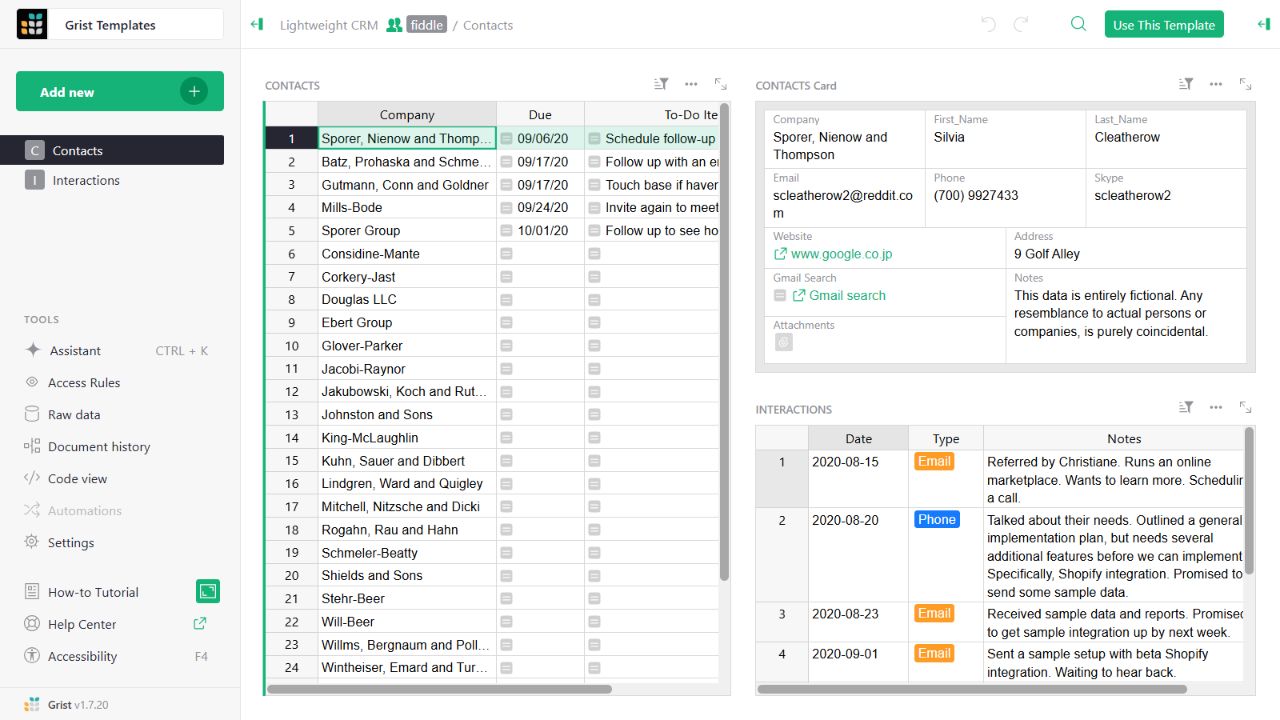
- Contact gridThe left widget lists sample companies and follow-up tasks.
- Detail cardThe upper-right widget presents fields for the selected contact.
- Related interactionsThe lower-right widget displays the sample interaction history.
Check the facts and their boundaries.
Official documentation supports the product statements. The evaluation procedures and synthetic examples are editorial guidance. We have not independently run the installation, migration or recovery procedures described here.
API key management, bearer authentication and JSON requests. Reviewed 2026-11-01.
Document/table/column identifiers and records endpoints; no live API execution. Reviewed 2026-11-01.